

Dear owners and carers,
As you know, science is humanity’s greatest ally. Scientific progress gives us medicines that cure disease or relieve pain. This has taken enormous effort, financial investment and, often, the generosity of researchers and volunteers.
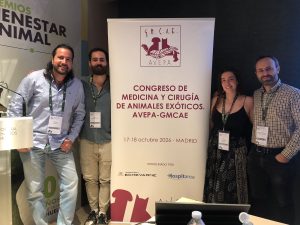
At ARACAVIA we collaborate with universities on a voluntary basis so our work goes beyond caring for your small animals’ health. It also includes teaching, welcoming dozens of students from Spanish public universities and vocational courses, helping train future professionals in the care of rabbits, rodents, birds, ferrets, reptiles and other companion animals. We also contribute to research and the development of medical knowledge about these species.
Now, we have been selected to collect samples from rabbits, rodents, ferrets and other exotic mammals to assess the presence of infections that can be transmitted to people. We will test for zoonotic parasites (Giardia sp., Cryptosporidium, Encephalitozoon spp., Balantioides coli, E. bieneusi, Blastocystis and others). Working with the University of Córdoba, the Carlos III Health Institute and with your help, we can expand knowledge of these species, which in many cases may ultimately improve our understanding of human health..
How can you help?
The required samples can be obtained with minimally invasive methods. We need:
- Rabbits, ferrets, rodents, hedgehogs and other pets:
- A small container of faeces. Samples must be frozen or collected that same day. Label the container with the owner’s full name, the pet’s name if registered at the clinic, the collection date and the animal’s species. We will remove your identifying details and assign a reference number known only to us so the sample is anonymous.
ALL WE NEED IS A SMALL CONTAINER OF FAECES!
What are the benefits?
- It is free.
- We will learn whether these infections are present in the animals, and that knowledge could benefit their future health.
- Knowledge of animal diseases directly affects people. Human health cannot be understood without considering animal health. Policymakers increasingly recognise that health is everyone’s responsibility, and vets are a first line of defence against diseases transmitted from animals. This is the ONE HEALTH approach.
How will we organise it?
Bring the sample directly to the clinic on the day you collect it; our staff will know what to do. You will also need to complete the online form:
Please also note that the deadline for taking part is 22 June. We will discuss the results at future check-ups or vaccinations.
To help, simply bring a sample to the clinic and complete the form. Together, we make science possible!