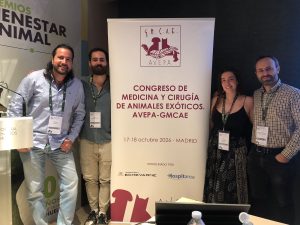

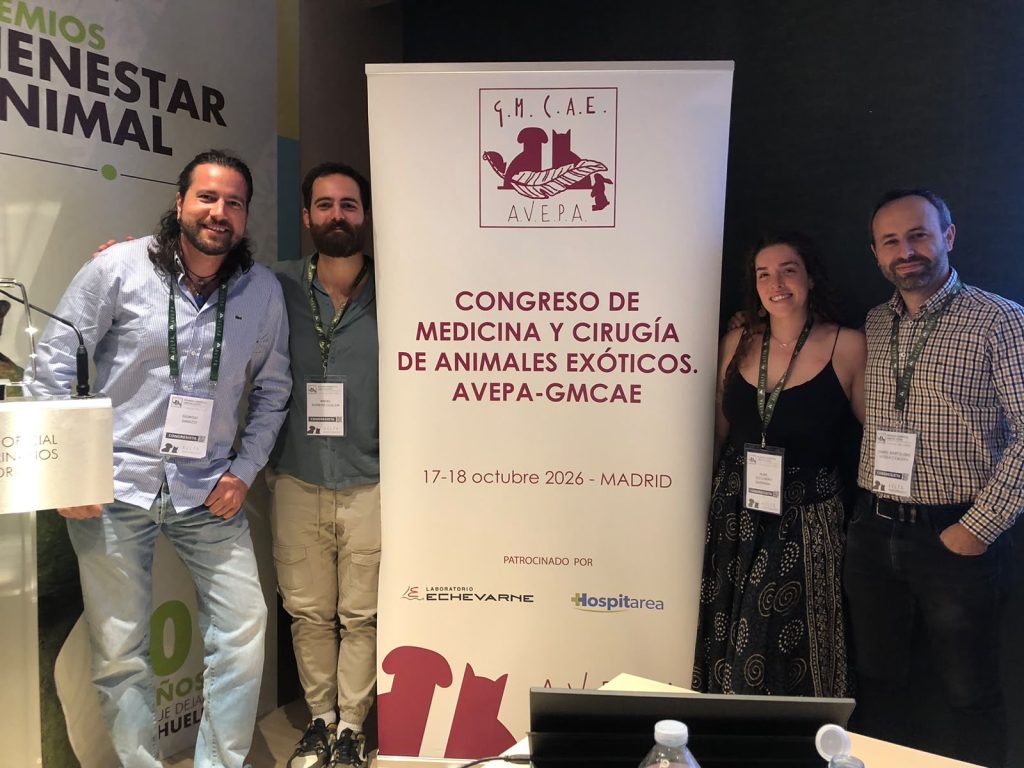
From 16 to 18 October 2026, members of our veterinary team attended the AVAFES Madrid Congress and the AVEPA-GMCAE Exotic Animal Congress. These two meetings allowed us to explore recent developments in exotic animal medicine and surgery, with a particular focus on birds.
At Aracavia, we consider continuing education an essential part of our veterinary work. Exotic animal medicine evolves constantly, requiring us to keep up with diagnostic techniques, treatments, surgical procedures and scientific research.
For this reason, we travelled to Madrid for several days of specialist training over the weekend of 16–18 October.
On Friday 16 October, Alba Escudero and Daniel B. Vázquez Calero attended the AVAFES Madrid Congress. The following day, Giorgio, Alba, Ángel and Daniel attended the Exotic Animal Congress organised by AVEPA’s Exotic Animal Medicine and Surgery Group (GMCAE), held at the Madrid Veterinary Association.
Below, we share some of the topics we found particularly interesting and their relevance to our patients’ veterinary care.
Kidney disease in birds: much more than measuring uric acid
One of the highlights of AVAFES Madrid was a lecture by vet Andrés Montesinos, focusing on the diagnosis and treatment of kidney disease in birds.
Kidney disease is a significant challenge in avian medicine. Signs are often non-specific and may resemble other conditions. Routine diagnostic tools also do not always detect kidney changes at an early stage.
A particularly interesting part of the lecture reviewed avian renal physiology and the limitations of commonly used biochemical markers.
Unlike in dogs, cats and people, in birds uric acid is one of the main products through which nitrogen is excreted. However, a blood uric acid concentration within the usual range does not necessarily rule out kidney disease.
This reinforces the importance of interpreting blood results in context. Assessing an avian patient properly requires integrating laboratory findings with the clinical history, physical examination and additional tests.
The lecture also addressed signs that may suggest kidney problems, including increased urine production, changes in water intake, weight loss and changes in droppings.
It reviewed techniques for assessing kidney function, from urinalysis to tests of renal filtration and markers whose usefulness in birds remains under investigation.
Another important topic was the treatment of articular and visceral gout, conditions associated with urate crystal accumulation. The session examined the difficulties of managing them and the need to tailor treatment to the cause, the patient’s overall condition and kidney function.
What did we take away from this lecture? Above all, the importance of a comprehensive approach to kidney disease, recognising the limitations of available tests and avoiding clinical decisions based on a single laboratory result.
Advanced diagnostic imaging: new ways to examine the inside of birds
The GMCAE scientific programme began on Saturday 17 October with a lecture on advanced diagnostic imaging and endoscopy in avian medicine, delivered by Yvonne van Zeeland, a European specialist in Zoological Medicine and lecturer at Utrecht University in the Netherlands.
This session explored the possibilities of different imaging techniques, particularly when conventional tests provide insufficient information.
Radiography remains fundamental in avian practice but has limitations because anatomical structures overlap. In certain diseases, ultrasound and computed tomography (CT) can provide valuable additional information.
Clinical examples covered respiratory, digestive and other internal organ disorders, highlighting how choosing the appropriate technique can change the diagnosis and treatment plan.
One key message was that the most complex test is not always necessary; the best choice is the one that can answer the clinical question.
For some patients, a well-performed radiograph may be enough. Others may need ultrasound, CT or endoscopy to advance the diagnosis.
Reviewing clinical cases helped clarify the advantages, limitations and applications of these tools across birds of different sizes and species.
Avian endoscopy: viewing lesions directly and obtaining samples
Endoscopy was a major topic in the advanced diagnosis sessions.
This technique uses small optical instruments to view certain internal cavities and structures directly. In avian medicine, it can be especially useful for lesions that are difficult to characterise using radiography or ultrasound alone.
The lecture demonstrated endoscopy in the respiratory and digestive systems, including examination of the trachea, crop and other parts of the gastrointestinal tract.
It also presented examples of coelomic cavity examination, the body cavity containing many of a bird’s internal organs, and applications of minimally invasive techniques.
As well as allowing direct observation of lesions, endoscopy can help obtain samples for further investigation in selected cases.
These techniques offer important diagnostic and therapeutic possibilities, but require specific equipment, training and careful risk assessment.
A central conclusion was the importance of integrating endoscopy into a reasoned diagnostic process, carefully selecting patients and situations in which it can provide a real benefit.
An update on internal medicine in parrots
Another major congress session focused on internal medicine in psittacines, the group that includes parrots, macaws, cockatoos, cockatiels, lovebirds and budgerigars, among other species.
The lecture reviewed complex diseases affecting these birds that require a particularly careful diagnostic approach.
These included avian ganglioneuritis, an inflammatory disease that can affect the nervous system and cause digestive and neurological signs. Diagnosis is challenging because clinical signs vary and there is not always a single test that can confirm or exclude the disease.
The session also reviewed nutritional and metabolic disorders, including those involving vitamin D, and several reproductive diseases.
Reproductive disease is common in psittacine practice, particularly in some female pet birds. Many factors may contribute, from nutritional status to environmental conditions and reproductive stimulation.
The session also covered cardiovascular diseases such as atherosclerosis, which can affect certain psittacine species and remain undiagnosed for long periods.
A particularly interesting point was the role of advanced imaging, including CT angiography, in investigating vascular abnormalities.
This update reminded us that avian diseases can affect several organs and systems at the same time, and recognising these relationships is essential to avoid incomplete diagnoses.
Anaesthesia in high-risk birds: planning, monitoring and recovery
Avian anaesthesia was another major congress topic.
In her lecture on anaesthesia and perioperative care in high-risk avian patients, Yvonne van Zeeland examined the features that make careful planning so important.
Birds differ markedly from mammals in anatomy and physiology. Their small size, respiratory characteristics and high metabolic activity can complicate anaesthesia, particularly when disease is already present.
One emphasis was the individual assessment of anaesthetic risk.
Before anaesthetising a bird, we need to assess its clinical condition, identify likely complications and decide whether stabilisation is needed first. It is also essential to consider which diagnostic tests are truly necessary, especially in very small or weak patients, where excessive handling may be harmful.
The lecture highlighted balanced anaesthesia, combining analgesic and anaesthetic techniques to reduce the amount of each drug needed where possible.
It also reviewed adequate ventilation, prevention of hypothermia and monitoring of cardiovascular function.
A particularly interesting section focused on anaesthetic monitoring, including the value of capnography in assessing ventilation and identifying complications.
One of the session’s most important messages, however, was that technology does not replace clinical observation. Trained staff dedicated to monitoring the patient and interpreting changes during the procedure remain indispensable.
Anaesthetic safety also continues beyond the end of a procedure. Recovery requires observation, temperature control, assessment of breathing and a low-stress environment.
These points are especially relevant to our daily work with birds of very different sizes, from small passerines to large parrots.
Behavioural medicine: understanding parrots’ needs better
One of the most useful lectures for pet bird carers addressed behavioural medicine in parrots.
Parrots have considerable learning abilities, complex social needs and natural behaviours that are not always easy to accommodate in a home.
The session examined common concerns including excessive vocalisation, aggression, repetitive behaviours and feather-damaging behaviour.
A key message was that behaviour that people find problematic is not necessarily abnormal for the bird.
Exploring and destroying objects with the beak, spending long periods foraging and making certain calls can all be natural behaviours in many species.
Without enough opportunities to express these behaviours, welfare and behavioural problems can develop.
The lecture also highlighted rest, the organisation of light and dark cycles, social relationships, environmental enrichment and the ability to choose between activities.
Another important point was the relationship between behaviour and disease.
If a bird plucks its feathers, becomes aggressive or suddenly changes behaviour, we should not immediately assume a purely psychological or environmental cause. Pain and other medical conditions can also influence behaviour.
Therefore, investigating a behavioural problem must include assessment of the environment and husbandry alongside possible medical causes.
This perspective is essential for realistic advice that improves birds’ welfare and their lives with people.
Clinical reasoning: learning to make better decisions
The programme also included a masterclass on avian clinical reasoning, based on diagnostic assessment and experience from a referral centre.
This training is particularly valuable because it examines the process leading to a diagnosis as well as the final outcome.
In veterinary medicine, especially with exotic animals, species-specific tests, firmly established reference ranges and extensively researched treatments are not always available.
Clinical reasoning and critical interpretation of scientific evidence therefore play a fundamental role.
The aim is not to request as many tests as possible, but to use the available information to build a differential diagnosis list, prioritise likely diseases and choose tests that can meaningfully change our decisions.
Reviewing complex cases also helps us recognise the limits of current knowledge, identify possible diagnostic errors and improve communication with owners.
Research into salmonellosis in urban pigeons
Scientific research also had a place at the congress.
Vet María Ardiaca presented a project funded by the GMCAE-AVEPA 2025–2026 grant, evaluating a slide agglutination test, known as the Widal test, for detecting antibodies against certain Salmonella antigens in rescued urban pigeons.
The presentation addressed a question of particular interest to vets treating urban birds: how to assess disease transmission risk and how reliable tests are for identifying potential carriers.
Pigeons are part of our urban wildlife and are increasingly rescued and brought to veterinary centres for care.
This creates health challenges for people handling them and for other animals sharing hospitalisation areas.
The talk encouraged reflection on the importance of validating diagnostic tests before using their results to make clinical or public health decisions.
It also reminded us that exotic animal medicine is closely linked to One Health , which recognises the connections between animal, human and environmental health.
Continuing education as part of our clinical work
These meetings offered an opportunity to update our knowledge, learn from other veterinary centres and consider improvements to our work.
One shared conclusion emerged from all the sessions: quality medicine combines current scientific knowledge, clinical experience, critical thinking and individual care for every patient.
Not every technique presented at a congress can be applied immediately in every clinic or patient. Some require specific equipment, others need further research, and many must be adapted to each species.
That is precisely why these meetings matter: they help us assess which procedures can improve diagnosis, which recommendations need reviewing and where scientific uncertainty remains.
At Aracavia, we remain committed to specialist training, research and collaboration with other professionals and institutions.
Our aim is to translate what we learn, progressively and rigorously, into better veterinary care for the exotic animals we see every day in Málaga.
Giorgio, Alba, Ángel and Daniel returned from Madrid with new knowledge, ideas and experiences that encourage us to keep advancing in our specialty.